The best automatic ceramic knife sharpener choices balance speed, edge quality, and ease of use. This guide highlights five top retractable, electric or rolling sharpeners ideal for home cooks, including those who own ceramic blades. Each product is evaluated for who it’s best for, its standout features, and practical limits. Below is a quick summary table of the chosen products to help you compare at a glance.
| Product | Type | Best For | Notes |
|---|---|---|---|
| Narcissus S867 Knife Sharpener | Electric, 3-in-1 | Home cooks wanting fast, burr-free edges | Diamond abrasives; ceramic knives supported |
| RazorSharp Knife Sharpener | Diamond-coated ceramic stones | Knives needing precise angle control | Adjustable 14–24 degrees |
| Chef’sChoice 15XV EdgeSelect | Electric, 3-stage | Edge conversion to 15–20 degree styles | 100% diamond abrasives |
| Brigii 4-in-1 Knife Sharpener | Multi-step, versatile | Various blades incl. ceramic and scissors | Three sharpening steps plus ergonomic grip |
| Narcissus Professional 2 Stage | Electric, 2-stage | Fast sharpening with final polish | Magnetic dust box |
Narcissus S867 Knife Sharpener

The Narcissus S867 combines a crude-slot and a fine-slot system for quick sharpening and polishing. It uses diamond abrasives to sharpen straight, serrated, and ceramic knives, and includes a scissors sharpener with a metal dust collection box. This model is best for home cooks who want fast edge restoration with burr-free results and occasional ceramic-knife care. A potential limitation is the need for careful blade insertion at the correct angle to optimize results.
RazorSharp Knife Sharpener With Adjustable Angle Guide

RazorSharp delivers professional precision sharpening with an adjustable 14–24 degree angle guide. Its diamond-coated ceramic sharpening stones provide a long-lasting edge for kitchen, professional, and chef’s knives. The guide assists users in achieving consistent angles, which helps maintain blade geometry. Best for users who want angle-control and durable stones; avoid this if you need serrated-edge sharpening that’s not explicitly supported by the guide.
Chef’sChoice 15XV EdgeSelect
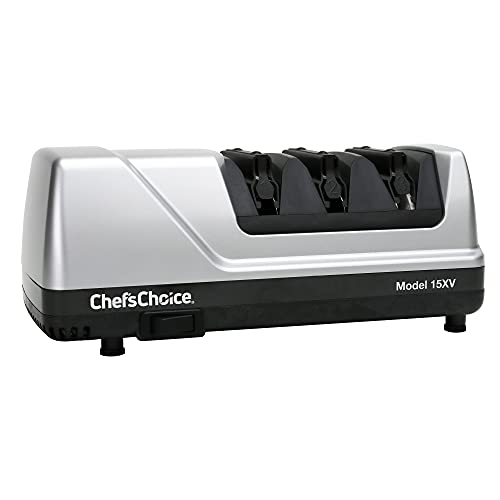
The Chef’sChoice 15XV EdgeSelect uses 100 percent diamond abrasives and precision angle guides in a three-stage system to convert traditional edges to Trizor XV 15-degree edges. It supports straight and serrated blades with easy on/off operation. This model is best for homeowners seeking a high-precision, professional-grade sharpener. A limitation is that serrated blades may require familiarization with the stage sequence for optimal results.
Brigii 4-in-1 Knife Sharpener

Brigii offers a compact, four-in-one sharpening system with coarse, medium, and fine steps and compatibility with ceramic and steel knives plus scissors. An ergonomic handle improves grip, and its broad blade compatibility makes it a versatile choice for mixed blade drawers. The potential drawback is that it may require more manual effort than fully electric models for some users.
Narcissus Professional 2 Stage Sharpener
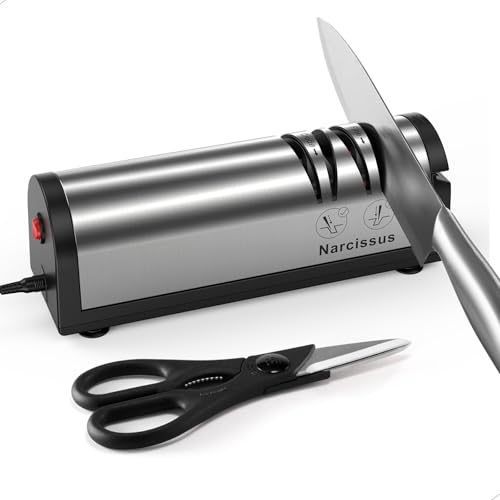
This Narcissus model uses a two-stage system to sharpen and polish, providing a burr-free edge quickly. It includes a magnetic dust collection box for cleaner operation and supports home use on straight-blade knives like chef and santoku knives. Best for buyers who want a simple, two-step workflow; beware that it may not accommodate serrated blades as effectively as three-stage systems.
Buying Guide
What sharpening need should guide your choice?
Consider whether you mainly sharpen ceramic blades, stainless steel, or a mix. Some sharpeners excel with ceramic knives, while others are designed for straight and serrated steel blades. Match the device to your typical knife collection.
What sharpening stages and angles matter?
Three-stage devices with adjustable angles offer broader versatility for kitchen and professional knives. If you primarily restore factory-edge blades, a two- or four-step model with a defined angle range can be sufficient. For precise edge geometry, look for 14–24 degree adjustments and diamond abrasives.
Is ease of use or capability more important?
Automatic or rolling sharpeners offer convenience and repeatable results, especially for home cooks. Manual or rolling devices may require more technique but can be gentler on delicate blades. Choose based on your comfort level and the blade types you own.
What safety features should you expect?
Look for stable bases, non-slip feet, and dust collection or magnetic features to keep particles contained. A magnetic dust box can simplify cleanup after sharpening ceramic and steel blades.
What maintenance is needed?
Diamond abrasives generally last longer than other abrasives, but sleeves and guides may wear over time. Regularly inspect the slots and guides for chips or misalignment, and replace parts as needed to maintain performance.
For ceramic knives: what to watch for?
Ceramic knives require careful handling. Choose sharpeners specifically rated for ceramic blades or with diamond-coated stones designed to minimize edge chipping and avoid excessive material removal.
FAQ
- Can I sharpen ceramic knives with any sharpener? Not all sharpeners are suitable for ceramic knives. Look for models that explicitly list ceramic compatibility or use diamond-coated stones designed for ceramics.
- Do these sharpeners work for serrated blades? Some models support serrated blades, others do not. Check the product features and stage configuration to confirm serrated compatibility.
- Is an adjustable angle guide necessary? An adjustable guide helps maintain consistent edge angles across different knife styles, which is helpful for maintaining performance over time.
- What edge angle is best for kitchen knives? A common range is 15–20 degrees per side, depending on knife type and manufacturer guidance. This range balances sharpness and edge durability.
- Should I choose a 2-stage or 3-stage sharpener? A 2-stage model is fast and simple for daily use. A 3-stage model offers more versatility for sharpening and polishing different blade types.
- Is automatic better than manual? Automatic and rolling sharpeners save time and improve consistency, but manual sharpeners can give you more control for nuanced edges on specialty blades.