Answering the need for precise, programmable heating with stable temperature control, these digital temperature controller hot plates are ideal for laboratories, teaching labs, and DIY electronics work. They are best for researchers who require accurate temperature regulation, consistent stirring when combined with a stirrer, and safe operation in compact workspaces. The top picks include units with digital displays, temperature probes, and safety features that help prevent overheating. The following overview highlights five models that balance control, capacity, and practicality for common lab tasks.
| Product | Best For | Key Feature |
|---|---|---|
| NORJIN 85-2 Lab Magnetic Stirrer Hot Plate | Moderate volumes, combined heating and stirring | Digital temp display, 212°F max, 200 W |
| VOEDOR 85-2 Digital Display Magnetic Stirrer | Easy temperature monitoring with stable heating | Digital display, 250 W heater, 0–2000 rpm |
| VOEDOR Digital Hot Plate Magnetic Stirrer (6.1” Plate) | Higher precision with corrosion resistance | Ceramic-coated plate, 0.1℃ control accuracy |
| LACHOI Lab Hot Plate Stirrer | Compact spaces with high temp needs | LCD display, up to 280℃, 5 L capacity |
| Soldering Hot Plate (Multi-Point Heating) | Electronics repair and PCB rework | Digital temperature control, 100×100 mm plate, 350 W |
NORJIN 85-2 Lab Magnetic Stirrer Hot Plate Overview
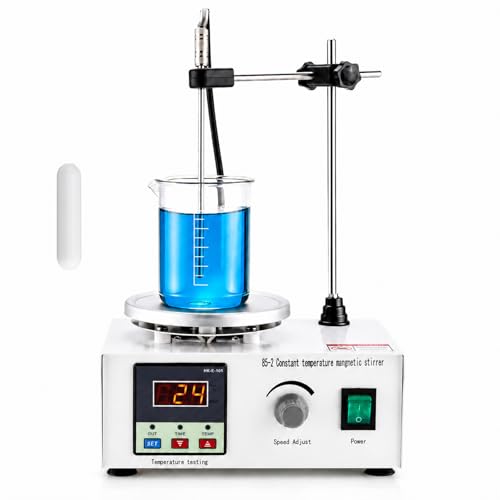
The NORJIN 85-2 pairs a 200 W heating element with a digital temperature display and a magnetic stirrer. It supports stirring up to 2600 rpm and heats liquids up to 212°F (100°C). The temp sensor can be placed with a flexible rod for precise readings, while non-slip feet and a built-in fuse add basic safety. This model is best for small-to-medium volumes where simultaneous heating and stirring are needed. A limitation is its maximum temperature of 100°C, which may not suit higher-temperature applications.
Who it’s best for: laboratories needing a compact, reliable stirrer-hot plate with straightforward digital temperature monitoring for routine sample preparation and reaction setups. Why selected: combines stable stirring with a safe, adjustable temperature target in a single unit.
VOEDOR 85-2 Digital Display Magnetic Stirrer

The VOEDOR 85-2 features a robust motor with stepless speed control up to 2000 rpm and a 250 W heating plate that reaches up to 212°F (100°C). Its 304 stainless steel surface ensures durability and good heat transfer, while a built-in fuse and non-skid feet provide safety and stability. The package includes four stirring bars, supporting longer experimental runs without new consumables. One limitation is that while it offers a strong stir and consistent heat, the maximum volume typically tops around 1000 mL, so very large batches may require alternative equipment.
Who it’s best for: labs and classrooms that need reliable digital temperature display with extra stirring versatility for routine sample prep. Why selected: strong balance of control, durability, and included consumables for ongoing use.
VOEDOR Digital Hot Plate Magnetic Stirrer (6.1 Inch)

This model delivers a 5 L maximum mixing capacity and a 0.1℃ temperature control accuracy with a maximum liquid control of 200℃. The ceramic-coated plate enhances corrosion resistance and easy cleaning, while an anti-overload fuse adds safety. It includes four stirring bars and an adjustable sensor rod. A caution: the higher accuracy and larger plate come with a larger footprint, which may matter in tight bench spaces.
Who it’s best for: researchers needing precise temperature control in slightly larger volumes with durable construction. Why selected: best combination of precision, corrosion resistance, and practical accessory inclusion.
LACHOI Lab Hot Plate Stirrer With LCD

The LACHOI unit combines a compact footprint with a surprisingly high maximum temperature of 280℃ and a 5 L capacity. The LCD display provides clear temperature readouts, and the device emphasizes space efficiency for small labs or demonstration setups. This model is especially suitable for chemical demonstrations or R&D workflows requiring higher heat while staying within a small bench footprint. Caution: ensure compatibility with the stirring needs of your specific liquids, as high temperature can affect some materials or vessels.
Who it’s best for: space-constrained labs needing high-temperature capability for small-to-medium batches. Why selected: a compact design with a high temperature ceiling and LCD readout for easy monitoring.
Soldering Hot Plate With Digital Temperature Control

Designed for electronics repair and PCB rework, this soldering hot plate offers a 100×100 mm heating area and a 30–400°C range. The digital temperature control helps maintain consistent heat across multiple joints, while the compact form supports tight workspaces. A limitation is that its primary focus is on soldering and rework rather than large liquid heating tasks, so it’s best for electronic components rather than large-volume lab experiments.
Who it’s best for: electronics technicians and hobbyists needing efficient multi-point heating for soldering tasks. Why selected: precise digital control on a compact, repair-focused hot plate.
Soiiw 110V 850W Soldering Hot Plate

This unit uses high-power heating (850 W) and a 200×200 mm plate for broader soldering applications, with a temperature range and a focus on quick, even heating. It is well-suited for component-level work, SMD rework, and other electronics tasks that demand reliable, uniform heat. Limitation: primarily designed for soldering and rework rather than chemical or liquid-based experiments.
Who it’s best for: electronics repair professionals needing ample heating area and rapid stabilization for soldering tasks. Why selected: strong heating capability and a broad plate size for multi-point heating tasks.
Inkbird ITC-308 Digital Temperature Controller

The Inkbird ITC-308 is a two-stage outlet thermostat designed for heating and cooling. It supports Celsius and Fahrenheit displays and features dual relays to manage a heater and a cooling device as conditions change. While not a hot plate itself, it is a common accessory for creating precise temperature environments when paired with compatible heating surfaces. Caution: ensure you select a compatible hot plate or heater to pair with the ITC-308 for your specific application.
Who it’s best for: users who want precise, programmable control for a heating system kit or multi-stage experiments. Why selected: flexible dual-relay control and clear display for accurate environmental management.
Buying Guide: Key Considerations For Digital Temperature Controller Hot Plates
What size and capacity do you need? Consider the maximum liquid volume and the desired stirring capacity if you require both heating and mixing. Larger plates and higher wattage support faster heating but take more bench space.
How precise must the temperature be? Look for a product with a tight control accuracy (for example, 0.1℃ in some VOEDOR models) and a stable temperature without significant fluctuation. Temperature probe quality matters for accuracy.
Is a safety feature important? Overload protection, hot warnings, splash guards, and stable non-slip feet help ensure safe operation, especially in busy labs or classrooms.
Do you need multi-point heating or simultaneous stirring? Magnetic stirrers with digital displays simplify monitoring, but if you don’t require stirring, a dedicated hot plate may be enough. Some models include a stand or accessories for better sensor placement.
What is the working environment? Ceramic-coated or corrosion-resistant plates resist chemical exposure and are easier to clean, making them preferable in wet-lab or chemistry settings.
How important is compactness? For small benches, choosing a compact unit with a high-temperature ceiling and a clear display can improve workflow efficiency without sacrificing performance.
Frequently Asked Questions
- What is a digital temperature controller hot plate?
A digital temperature controller hot plate combines a heating surface with a digital display and temperature sensor to maintain a specified temperature for samples or reactions. - Should I prefer a unit with a temperature probe?
Yes, a probe enables precise feedback and stable, uniform heating, especially for sensitive samples and emulsions. - Is a higher wattage always better?
Higher wattage can heat faster and support larger volumes, but may require more bench space and stronger power supplies. Match wattage to your task. - Can I use these with glassware or flasks?
Most models are compatible with common lab glassware, but always check the plate size, heat distribution, and vessel compatibility before use. - What maintenance is needed?
Regular cleaning of the plate, sensor, and probe; verify any protective coatings; inspect cords and connectors for wear; and replace consumables like stirring bars as needed. - Are these units suitable for electronics soldering work?
Some units are designed with multi-point heating for soldering and rework, offering precise digital control ideal for electronics tasks. Check the plate size and temperature range to ensure suitability.