Looking for the best super sharp knife sharpener to restore and maintain razor-edged blades? This guide highlights five top options that cover a range of knife types—from straight edges to serrated blades. Suitable for home cooks, professionals, and outdoor enthusiasts, these sharpeners emphasize quick results, safety, and simplicity. The selections below help you choose by use case, ease of use, and edge quality.
| Product | Best For | Key Benefit |
|---|---|---|
| AccuSharp Knife Sharpener | Everyday kitchen knives | Fast, durable carbide sharpening |
| 5 Precision Adjust Knife Sharpener | Precision sharpening | Multiple angles for straight-edge blades |
| Kitchellence 3-Stage Knife Sharpener | Versatile restoration | 3-step system with safety glove |
| Orange Ninja Serrated & Kitchen Knife Sharpener | Serated blades | 4-stage system including serrated slot |
| Work Sharp Precision Adjust Elite Knife Sharpener | Professional-grade control | Fixed-angle guides with serration option |
AccuSharp Knife Sharpener

Best for: Home cooks who want a quick, reliable edge on common kitchen knives. This sharpener uses diamond-honed tungsten carbide blades for durable sharpening and reversible blades to extend life. It excels at fast edge restoration, including straight and serrated blades, with a simple, two-stroke process. Caution: Not designed for heavy damaged blades or unusual blade geometries; for severely damaged edges, professional servicing may be required.
5 Precision Adjust Knife Sharpener
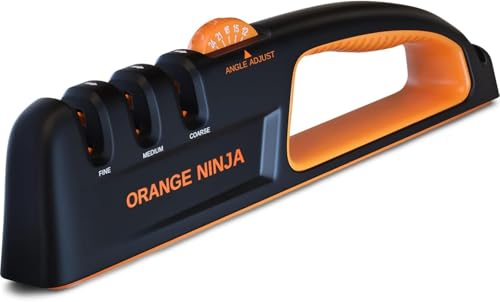
Best for: Users who want precise control over sharpening angles. This 3-stage sharpener supports multiple fixed angles (12°, 15°, 18°, 21°, and 24°) for straight-edge blades, helping maintain blade geometry. Not suitable for serrated blades or scissors. Caution: The device is designed for straight-edge knives only; serrated edges require a different tool or method.
3-Stage Kitchellence Knife Sharpener
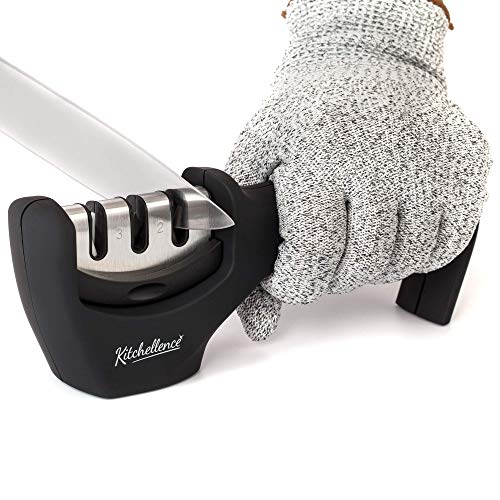
Best for: Kitchen setups needing a comprehensive restoration and polishing cycle. The 3-slot system first repairs, then sharpens into a V-shape, and finally polishes the edge. An included cut-resistant glove adds safety. Use this when blades are dulled or slightly damaged and you want an all-in-one tool. Limitation: The design targets standard kitchen knives; specialty blades may require alternative methods.
Orange Ninja Serrated & Kitchen Knife Sharpener

Best for: Homes with a mix of straight-edge and serrated blades. This 4-stage system offers coarse, medium, fine, and a dedicated serrated slot, enabling both repair and honing. It is easy to use and accommodates both right- and left-handed users. Caution: Some users may prefer a dedicated diamond-rod or ceramic approach for ultra-fine edges on specialty blades.
Work Sharp Precision Adjust Elite Knife Sharpener

Best for: Home cooks and hobbyists who seek professional-like control. This sharpener offers adjustable angles from 15° to 30°, a dedicated conical ceramic rod for serrated blades, and compatibility with a range of kitchen and outdoor knives. Better for users who want customizable sharpening geometry. Limitation: Slightly more complex setup than single-slot models; initial learning may take a moment.
Buying Guide: Key Considerations for Choosing a Super Sharp Knife Sharpener
- Knife types supported: Do you need to sharpen straight-edge blades, serrated knives, or both? Some three- and four-slot models support serrated edges; others are designed for straight-edge blades only.
- Sharpening angles: Fixed-angle sharpeners provide consistency, while adjustable-angle models allow customization for different knife families (Japanese, Western, hunting, etc.).
- Edge restoration vs. honing: Some tools repair damaged edges first, then hone and polish; others focus on quick edge maintenance. Consider the condition of your knives.
- Safety features: Non-slip bases, included cut-resistant gloves, and ergonomic handles reduce the risk of slips during sharpening.
- Maintenance and blade life: Diamond abrasive blades tend to last longer and maintain sharpness, while ceramic or basic carbide options can require more frequent replacement.
- Portability and storage: Compact, lightweight models are easier to store in small kitchens or for travel; larger units may offer more stability.
Frequently Asked Questions
- What is the best knife sharpener for serrated blades?
– Models with a dedicated serrated slot or conical ceramic stage tend to deliver better results on serrated edges, such as Orange Ninja and SHARPAL styles. - Can I sharpen any knife with a general-purpose sharpener?
– Many are designed for most straight-edge kitchen knives; serrated blades and specialty knives may require specific tools or methods. - How often should I sharpen my knives?
– Regular maintenance reduces dulling; the frequency depends on use, blade material, and sharpening method. - Are manual sharpeners safer than electric ones?
– Manual sharpeners offer controlled pressure and reduce risk when used properly. Safety features like non-slip bases further enhance safety. - What does a multi-stage sharpener do?
– Multi-stage devices repair, restore geometry, and polish edges, providing a complete edge refresh in one tool.